New - 2 Days Ago
.jpg)


TL;DR
For right-sizers evaluating Centennial, the Cherry Creek Trail's Centennial segment is flat, paved, and genuinely usable for daily walking — but which access point works best depends on whether you plan to walk from your front door or drive to a trailhead, and the gap between those two realities is wider than any trail map shows. The practical decision turns on three variables in combination: which access point fits your parking and mobility needs, which neighborhood puts you within walking distance of that point, and which housing type in that neighborhood actually matches right-sizer priorities.
Every Cherry Creek Trail guide shows the same map — mileage markers, trailhead pins, parking lot coordinates — but none of it answers the question a right-sizer is actually asking. How do I get to the trail from my front door? Is the parking lot close enough to matter? Can I make this part of a Tuesday morning routine, not just a weekend outing?
Standard trail resources cover the full 40-plus mile span from Confluence Park in downtown Denver southeast through Arapahoe and Douglas Counties, passing through Centennial and Parker. That's useful orientation. What it doesn't tell you is that lack of clear guidance on which Centennial trail access points are actually easiest for older adults or right-sizers to use day to day is one of the most consistent gaps in how this trail gets described online.
General trail maps and mileage do not answer the real question of which access points are most convenient for routine use. A pin on a map tells you a trailhead exists. It does not tell you whether the parking lot is a 50-foot walk to the trail entry or a 400-foot hike across gravel. It does not tell you whether the approach from a nearby neighborhood involves a safe crossing or a busy arterial with no pedestrian infrastructure.
What this article covers that trail maps don't: which Centennial access points are genuinely usable for daily walking, which have reliable parking and restrooms, which neighborhoods put you close enough to walk without driving, and how to connect trail access to nearby downsized housing options — the four variables that determine whether trail access is a real lifestyle feature or just a marketing claim.
The trail is long enough that where you access it matters enormously. Two Centennial neighborhoods a mile apart can have completely different day-to-day trail experiences depending on which side of a busy arterial they sit on, whether there's a marked crossing, and how far the nearest lot is from the actual trail entry. That's the gap this article is designed to close.
Right-sizers who want to see how home type selection in Centennial connects to these lifestyle-access priorities should also look at which main-floor primary home options in Centennial and Greenwood Village align with this kind of daily-routine thinking.
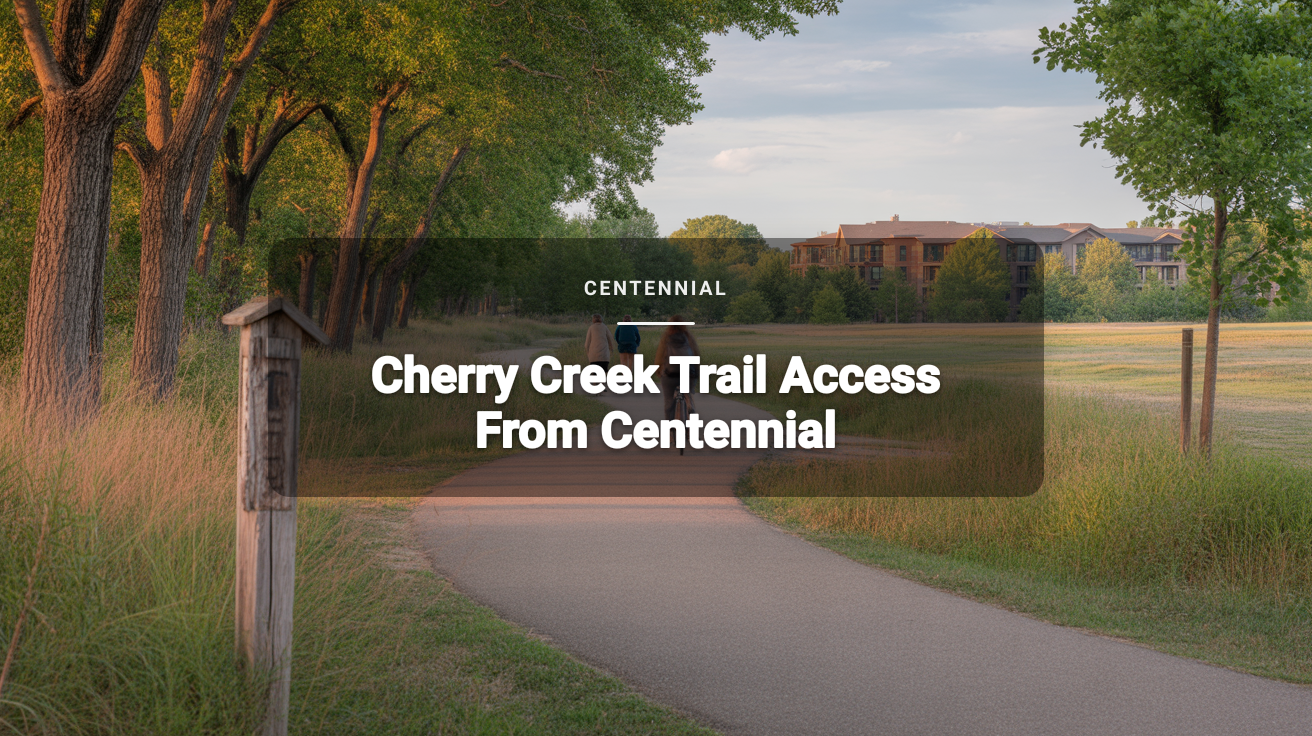
Forty-plus miles sounds like a trail built for serious cyclists training for a race. The Centennial segment is something different — flat, paved, and designed for exactly the kind of daily walk a right-sizer wants to build into a morning routine.
The Cherry Creek Regional Trail runs approximately 40 to 47 miles from Confluence Park in downtown Denver southeast through Glendale, Aurora, Centennial, Parker, and Franktown, with management shared across Arapahoe County (which covers Centennial) and Douglas County. Through the Centennial corridor, the trail surface is primarily paved concrete or asphalt, approximately 8 feet wide — not too hilly, accessible, and suited for walking, biking, or dog-walking without the steep inclines that make other regional trails impractical for everyday use. The trail is genuinely not too hilly through this stretch, which is a meaningful differentiator for right-sizers who have ruled out other Front Range trails on terrain grounds.
The southern rural extension near Franktown includes short gravel sections, but that's relevant only for right-sizers considering the far southern end — not the practical daily-use zone for most Centennial residents. For the purposes of daily walking, the paved corridor through Centennial is what matters.
Centennial sits in the middle-to-southern portion of the trail, not at either terminus. That positioning matters because easy trail access from Centennial means access to a well-developed, paved, flat segment — not a trailhead at the end of a long rural extension.
Here's the part that most trail descriptions skip: the trail's full length is essentially irrelevant to daily use. What matters is the half-mile between your front door and the nearest access point, and that varies significantly by neighborhood. A right-sizer in one part of Centennial might walk out the door and reach the trail in ten minutes on a flat sidewalk. A right-sizer in another part of the same city might face a busy arterial crossing, no pedestrian underpass, and a parking lot that's the only realistic option.
Cherry Creek starts near Franktown in Douglas County and ends at Confluence Park in Denver — but for right-sizers, the relevant question is not the full trail span. It's which segment is reachable from a specific front door or a specific parking spot. That's where the next section starts.
A trailhead pin on a map tells you where the trail is. It does not tell you whether the parking lot puts you 50 feet from the trail entry or 400 feet across a gravel lot — and for right-sizers with limited mobility, that distance is not a minor detail.
The Cherry Creek State Park north entrance area, off Parker Road and Orchard Road, offers the most vehicle-friendly entry for Centennial residents. Multiple large parking lots — including the Tower Loop lot as a named reference point — provide the kind of plentiful, close-to-the-trailhead parking that makes a trailhead with parking and restrooms feel like a practical access point rather than a logistical obstacle. For a couple downsizing in Centennial who want a trailhead with easy parking, restrooms, and a simple in-and-out experience, the state park's north entrance is the most consistent option available.
Parking is easy here relative to other access points — but there's a real planning concern worth naming directly. Parking uncertainty at trailheads is a genuine friction point, especially whether spaces are convenient, plentiful, and close enough for limited mobility. Not all lots within the park are equally positioned relative to the trail entry. Before relying on a specific lot, verify current lot availability and any seasonal closures with Arapahoe County Parks directly — lot configurations and access can shift.
One durable structural fact that changes the calculus for home selection near the park: pedestrians and cyclists entering Cherry Creek State Park on foot or by bike are not subject to the vehicle day-use fee. Right-sizers who live close enough to walk or ride in avoid the fee entirely. That makes the home's distance from the park boundary a real financial and lifestyle variable — not just a convenience preference — and it's a factor worth building into a home search, not discovering after closing.
For right-sizers who want to reach the trail without driving at all, the University Boulevard crossing near the northern Centennial edge and the Colorado Boulevard crossing near Glendale offer street-level access with available street parking. These function as practical access points for adjacent neighborhoods — useful for shorter daily strolls rather than extended park loops.
Access point comparison at a glance:
Cherry Creek State Park (Parker Rd / Orchard Rd): Multiple large lots, restrooms, fee-free pedestrian entry, best for driving access and weekend routines. Verify current lot configuration with Arapahoe County Parks.
University Boulevard crossing: Street parking, midpoint access, walkable from adjacent neighborhoods, connects to urban trail sections. Best for shorter daily walks from nearby homes.
Colorado Boulevard crossing (near Glendale): Street parking, positions users near local amenity corridors, lower traffic exposure than central urban sections. Best for right-sizers in the northern Centennial transition zone.
Knowing which access points work best for driving versus walking raises the next question: which Centennial neighborhoods actually put residents close enough to use the trail without a car every time — and that answer depends on more than distance.
"Close to the trail" appears in listing descriptions across Centennial — but close enough to walk to and close enough to drive to are two completely different lifestyle realities for a right-sizer who wants the trail to be good for a quick daily walk, not just an occasional outing.
Walkable trail access — meaning a right-sizer can leave their front door and reach the trail on foot without driving — is the highest-value lifestyle configuration for daily use. It's also the configuration that requires the most precise home selection. Being within the broad Centennial city boundary is not enough. The relevant question is whether a specific home is within a specific proximity band to the trail corridor or a neighborhood crossing, with a safe and flat approach route connecting the two.
Here's what listing descriptions consistently leave out: terrain and approach routes that may be scenic but less practical if the access path is hilly, awkward, or requires a longer drive are a real barrier — even when the mileage looks short on paper. A neighborhood that is technically close to the trail but separated by a busy arterial without a safe pedestrian crossing, or by a route with elevation change, reduces practical walkability even if the map distance looks manageable. The approach route is the variable that no listing description mentions.
A right-sizer who wants a neighborhood where they can walk to the trail without needing to drive every time should evaluate homes by asking four specific questions before making an offer:
Walkability checklist — ask before you offer:
Neighborhoods adjacent to Cherry Creek State Park's western and northern edges, and those near the University Boulevard and Colorado Boulevard crossings, historically offer the shortest walk-to-trail distances for Centennial residents. Buyers should verify current trail access points and neighborhood boundaries with Arapahoe County GIS or a local agent before assuming proximity based on a map — trail access infrastructure can and does change.
This configuration fits right-sizers who want daily walking as a health routine and do not want to depend on a car for every trail visit — particularly those downsizing from larger suburban homes where driving was the default for every errand and every outdoor activity. The goal is not just trail access on paper. It's trail access that becomes walkable from nearby neighborhoods and works as a genuine part of a daily routine.
Walkability to the trail is one side of the equation. The other is whether the nearby housing options actually fit a right-sizer's needs — and that connection is what most trail guides never make. For a comparison of how walkable trail and lifestyle access differs across adjacent south Denver communities, what downsizers notice first about daily life in Greenwood Village versus Centennial and Cherry Hills covers the contrast in practical terms.
Most right-sizers find the trail first and the home second — but the homes that actually deliver on daily trail access are a much smaller subset of the Centennial market than the listing descriptions suggest. No obvious connection between trail access and nearby downsized housing options is one of the most consistent gaps in how buyers approach this search, and it makes it harder to choose a home based on lifestyle fit rather than just square footage and price.
Someone choosing a smaller home who wants to stay close to the trail for daily exercise but avoid steep or inconvenient access routes needs to search within a specific proximity band to the access points that actually work for them — not just within the broad Centennial city boundary. That means identifying which access point fits their mobility and parking needs first, then filtering the home search around that point, then evaluating housing type within that zone.
The proximity premium is real near Cherry Creek State Park — but paying more for trail adjacency only makes sense if the specific home's approach route and property type actually support the daily routine the buyer is planning. A home that is close to downsized housing clusters and also within walking distance of a practical trail entry is a genuinely rare combination. Buyers who find it should understand they are paying for both variables, not just the address.
Downsized housing options near the Cherry Creek Trail corridor in Centennial have historically included patio homes, paired homes, and lower-maintenance condos — particularly near the state park edges and along trail-adjacent neighborhood nodes. Buyers should verify current listing inventory and neighborhood boundaries with a local agent, since the mix of property types shifts by sub-area and changes over time.
Main-floor primary bedroom homes and low-HOA patio homes near the trail corridor are the property types most aligned with right-sizer priorities. Buyers should filter specifically for these types rather than assuming any Centennial home near the trail will fit their maintenance and accessibility needs. One honest trade-off to name directly: homes closest to Cherry Creek State Park and the trail corridor often carry a proximity premium. The lifestyle value of walking to the trail is priced into the market. Right-sizers should weigh whether that premium is worth it compared to a home slightly farther away with easier parking access to the same trailhead — particularly if the farther home is close to downsized housing with lower HOA exposure.
Before making an offer on any home marketed as trail-adjacent, walk the actual route from the front door to the nearest trail entry point. Confirm the crossing or access infrastructure is in place. Ask the listing agent whether the HOA (if applicable) has any restrictions on trail-related use or parking near the trailhead — these are property-specific and must be confirmed in the HOA resale disclosure, not assumed from neighborhood marketing.
For a direct look at which specific home types near the trail corridor align with right-sizer accessibility and maintenance priorities, how main-floor primary homes in Centennial compare for right-sizers covers the property-type decision in detail. And if you're weighing whether an older trail-adjacent home or newer construction farther from the trail better fits your maintenance tolerance, the maintenance reality of older homes versus new construction for Denver right-sizers lays out that trade-off honestly.
Trail access and housing type are two of the three variables. The third is whether the broader neighborhood supports the rest of a right-sizer's daily life beyond the trail itself.
A trail is only as useful as the neighborhood around it. Right-sizers who have done this before know that the walk is the easy part — it's the rest of the daily routine that determines whether a neighborhood actually works long-term.
Trail access is most valuable when it sits within a broader daily convenience corridor. Right-sizers evaluating Centennial access points should also assess whether the surrounding area supports grocery runs, medical appointments, and casual dining without requiring long drives. The goal for many is to consolidate the daily routine — trail walk, grocery stop, coffee — into a single neighborhood zone rather than driving to separate destinations for each activity. That's the lifestyle configuration that makes easy trail access from Centennial genuinely low-friction rather than just theoretically convenient.
The Parker Road and Orchard Road corridor near Cherry Creek State Park's north entrance historically anchors a mix of retail, dining, and service amenities that supports this kind of consolidated daily routine. Buyers should verify the current business mix along this corridor with a local agent or a recent visit — retail composition shifts over time, and what's there today may not be there in two years.
The honest trade-off: the most trail-convenient Centennial neighborhoods near Cherry Creek State Park also sit along one of Centennial's busier arterials. Parker Road makes the trailhead easy to reach by car. It also means the surrounding neighborhood carries more traffic noise and volume than a right-sizer might expect from a listing description that leads with "trail access." Evaluate whether the convenience of the amenity corridor outweighs the noise and traffic exposure of living near a major arterial — that's a question worth answering before, not after, an offer.
Much of Centennial falls within the Cherry Creek School District boundary. Right-sizers without school-age children often discount this entirely — but the district's reputation affects neighborhood stability and resale value in ways that matter even when school quality is not a personal priority. Verify the current district boundary for any specific address using the Cherry Creek School District's official boundary tool, since zone lines do not always follow neighborhood marketing descriptions.
For a fuller picture of how the district boundary affects neighborhood value and resale for buyers without kids, what the Cherry Creek School District means for right-sizers without school-age children covers the resale and stability implications directly.
Daily convenience and trail access together narrow the field significantly — but the final question is how to evaluate specific access points against each other and make a decision that holds up over time. That's where a concrete pre-offer workflow matters more than any trail map.
The gap between "trail-adjacent" in a listing description and "I can walk to the trail from my front door every morning" is exactly the gap this checklist is designed to close — and it's a gap that costs right-sizers real lifestyle value when it goes unexamined before closing.
Lack of clear guidance on which Centennial trail access points are actually easiest for older adults or right-sizers to use day to day is a documented friction point in how buyers approach this search. The answer is not a better map. It's a verification workflow that starts with physically walking the route from the prospective home's front door to the nearest trail entry point before making an offer.
Four questions to ask at every access point:
Two homes in the same Centennial neighborhood can have completely different trail access realities depending on which side of a busy arterial they sit on. The listing description will not tell you which one you are buying. That's the specific gap that makes a physical route walk — before the offer, not after — a non-negotiable step in this search.
For homes near Cherry Creek State Park, confirm whether the property is close enough to the park boundary to enter on foot without the vehicle day-use fee. This is a durable lifestyle and cost variable that should be part of the home evaluation, not something discovered after closing.
No obvious connection between trail access and nearby downsized housing options is what makes this search harder than it should be. The practical resolution is to treat trail access as a verifiable criterion with a specific workflow — not a marketing claim to take at face value. Ask the listing agent whether the neighborhood HOA has any restrictions that affect trail use, parking near the trailhead, or access to adjacent open space. These restrictions are property-specific and must be confirmed in the HOA resale disclosure.
The decision ultimately turns on three variables in combination: which access point fits your mobility and parking needs, which nearby neighborhood puts you within walking distance of that practical access point, and which housing type in that neighborhood matches your right-sizing priorities. No trail guide resolves all three — but a local agent who works with right-sizers in Centennial can help you evaluate specific addresses against all three criteria before you write an offer.
To apply this verification framework to current Centennial listings and identify which homes are worth walking the route for, browse current Centennial homes filtered by neighborhood and proximity. And if part-time work is still in the picture, how the Centennial commute to DTC actually works for right-sizers helps you evaluate whether the same neighborhoods that offer trail access also support a manageable commute.
Once the verification workflow is complete, the decision is no longer about the trail. It's about whether the whole neighborhood delivers the right-sizing lifestyle you're building toward — and that's a question worth answering with specifics, not assumptions.
Your Real Estate Expert. Regarding real estate in the Denver Metro market, you deserve an expert who places your needs above all else. I'm Brian Burke, a licensed REALTOR® and seasoned real estate broker and owner of Kenna Real Estate with over two decades of experience. I've helped hundreds of home buyers and sellers navigate every transaction, and my comprehensive industry knowledge spans from appraisal to mortgage to real estate expertise.
My dedication to excellence has earned me recognition as a pricing specialist. This allows me to find the best solutions for even the most unconventional transactions to benefit my clients. Consider me your trusted Real Estate advisor for your next transaction, whether it's for yourself, a loved one, or a friend. Always choose an agent who aligns with your needs, even if that means exploring other options.
You may not be aware that I've held a REALTOR® license since 2002, dedicating my time to becoming an authority in all aspects of Residential Real Estate and Construction. In addition, I established my own Real Estate brokerage firm, providing comprehensive 360-degree Real Estate services, from the initial acquisition of a client's first Real Estate asset to the disposition of their entire Real Estate portfolio.
My commitment is unwavering in delivering top-notch service that consistently exceeds my clients' expectations, whether you're selling or buying. Even after the transaction is complete, I remain your lifelong REALTOR®, ready to assist you at any time. When you, your family, or friends choose me as your Real Estate agent, I promise to be the best agent you've ever worked with in the Real Estate industry.
Proudly serving Arapahoe, Douglas, El Paso, Denver, Jefferson, Weld, Lairmer, Elbert, Broomfield, Boulder, and Adams Counties! I have a team of anents in most Colorado cities from Fort Collins, to Grand Junction, to Denver, and Colorado Springs.
This is what You Get when I sell your house:
When it comes to your real estate, trust in a dedicated professional who puts your goals first. Contact me, Brian Lee Burke, today, and let's turn your real estate dreams into reality.